Friday, March 20, 2009

Hampi


an excellent day at Sarath's home

1 an ancient palm-leaf text
2 the Ayurvedic medicine cabinet
3 a hanging bed (I want one)
4 Sarath with his family's sword-heirloom


A Heart-warming party

The other day, Ghootam and Anu, a married couple working at Vijnana Kala Vedi, moved into a new house and threw a housewarming party. The first thing that must be known about Ghootam and Anu is that they are the cutest couple I have ever seen, in cinema and out. They even share a banana leaf at meals. There was a great deal of curiosity among the students at VKV about whether they were a love match or had had their marriage arranged. Finally, someone simply asked Anu straight out and she replied that yes, she and Gautam are a love match. This left me somewhat worried because sometimes love matches lead to strained relationships with other family members and I really wanted them to have entirely happy lives because they are such loving, kind people. The housewarming party laid all my fears to rest.
Ghootam’s parents are wonderful, intelligent, loving people. If any couple could contest Ghootam and Anu being the world’s most adorable couple, it’s them. They seem to be constantly aware of where the other is in the room and will occasionally shoot a smile to them that would bring joy to the heart of any who witnessed it. The intensity of the loving glances they exchanged was so intense I almost felt as though I were eavesdropping on a private conversation.
This couple is so full of love that it has spilled out in an amazing way to encompass a large number of people. They are both teachers and taught in the government schools for a while, but they realized that something was missing there. While schools in Kerala are some of the best in India and Kerala has the highest literacy rate, students are not taught how to use their knowledge. Ghootam’s father said that schools merely taught criminals how to read and write. So they left the public school system and designed their own, one based on studying the arts and promoting a loving family atmosphere as well as learning the standard subjects of education.
There are eleven students at present; the youngest, little Aku, is just six and the eldest, Harish, is twenty-one. All of them live in the same house with their teachers. I was fortunate enough to share a meal with them. Everyone had left the party to go home except me, two other girls from VKV, and this extended family of students. Even though I couldn’t follow the conversation, I laughed at all of the jokes because their laughter was so infectious. I probably even laughed at the “why is that silly American girl laughing, she doesn’t speak Mallayallam” joke.
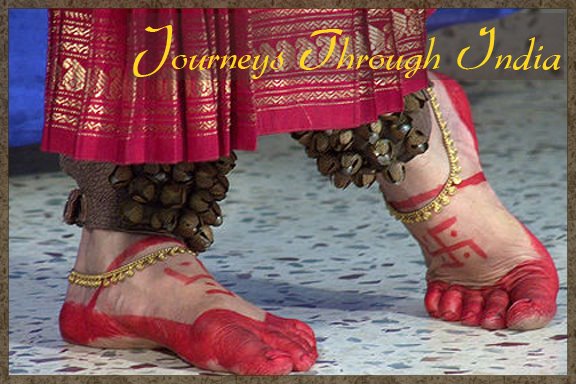
After the meal, we talked about various things, looked at photos of their recent trip to Rajasthan, laughed a lot, and played music. All of them sing, Harish plays tabla quite well, and there is a violinist and two flute players. I also witnessed and participated in a Bharatha Natyam mini-performance.
I was loath to leave such a happy home, to say the least. The children ran after the rickshaw waving and I shouted “Naleh Karnam” (see you tomorrow) with the best of them. (Actually, I think I mispronounce it because they laugh every time I say it.) When I arrived home, I was already nostalgic and regretting that a week was all the time I had left here. At the same time I was wildly happy, slammed the door as I ran in, and was practically bubbling over with joy as I recounted the night’s events to Mom. What other response is possible in the face of such love? Jannet, one of the other girls, and I already have plans to ask Gautam if he will adopt us into his family as well.

Thursday, March 19, 2009

Linda: Joys too Numerous to Recount March 20

Joys too Numerous to Recount

Every day brings a new joy, a new story, a new friendship. The days here at the Center are quite full, especially with our daily visits to the hospital for Eleanor’s massage treatments for her knees, and there has been little time to recount the days in writing. (These sessions at the hospital were a source of joy for both of us. She received her 30-40 minute massages which have helped her knees tremendously and we both were able to have long conversations with Sarath, whose companionship has become, in a very short time, a precious gift.) So, many moments, so many kindnesses, so many evenings, so many interchanges will remain treasured memories to share with family and friends, as the conversation flows once we return home. Every person has a special quality, a special vibrancy and genuineness – from the tailor, to the people at the hospital, to the families we met, to all the people who work here, to the shopkeepers, and to the teachers, who share their love of their art and the hearts with us. Could we come back? Would it be the same? Nothing ever is, but there is much here yet to explore. We shall see.

Starting on a note of hilarity were the local cricket matches that began shortly after our arrival – much to the joy of the visitors and the staff. One must realize that cricket is THE GAME in India. It is played everywhere, all the time. It is quite serious and competitive, and much loved. You will see more children playing cricket than I ever saw playing baseball or basketball – even in the days when children actually played outside! I was only able to play in one game here – I seemed to often have other commitments during game time – so perhaps Eleanor will relate the spirit of these games in more detail. I, however, am obliged to tell you of my first attempts at bowling! Bowling in cricket is analogous to pitching in baseball, except that you have to throw it with a straight arm instead of a bent one. The other difference is that every player has to bowl, or pitch. There isn’t one superstar pitcher on a team – every member has to be a decent batter, a decent bowler, and a decent outfielder. The idea of bowling is NOT to pitch it to the batter for the batter to hit (or better yet, to miss). The point of bowling is to hit these three sticks stuck in the ground behind the batter called stumps, which has a small piece of wood placed on top called a wicket. If you knock down a stump, the batter is out. The object of the batter is to protect the stumps. So, it doesn’t matter if he swings and misses. All that matters is that the stumps are protected. Then, if he hits the ball hard enough, he and his partner can run to opposite stumps (it’s optional) – hopefully before the outfielders throw the ball and either tag the runner or knock over the stumps before the runner is safe. So … my turn to bat. The skills learned at Tracker School once more come to save the day … almost. I take a few steps back, wind-up, and throw the ball, just like I learned to throw hunting sticks long ago, thanks to Eleanor’s reminder: the tell-tale pointing of the finger toward the object you are trying to hit just as you release the ball/stick from your hand. Lovely. Straight, straight, straight to the batter. Slow, slow, slow. I have absolutely NO POWER! It certainly was straight, but that throw wouldn’t have knocked a fly off course! I couldn’t have given that batter a better chance to hit a ball. TWACK!! That ball flew out of the field … and the batter scores 6 points. Three times he hits it out of the field before my turn to bat is over, which, thankfully, was quite soon. (I only had to throw 6 good throws, which I did in good order.) In a short time, the other team had chalked up 18 points off of my bowling! Thankfully, the game was in good spirits … and we were still slightly ahead. The next bowler was an Indian and a good bowler. Admittedly, I was quite relieved when the batter hit that ball out of the field as well. Alas, on the next bowl, the batter was out – which happened to be the end of the game, and we won by only a few points. It was all very exciting. We had a break for tea, and afterwards, a new game resumed. I, however, went to the room for some reason, so I missed out on Game 2.

There were a few stories I want to recount, three of which are stories my singing teacher, Santosh, told me regarding some of the ragas I was learning. The first was a story about Narayan, one of the great, great sages of music from the times of legend. This great sage of music was so renowned that he frequented all three realms, playing for the gods, for the rakshasas (jinn), and for humans. He played the most revered instrument in Classical Indian music, that instrument of Sarawati, the goddess of music, herself – the veena. He was, however, also quite arrogant. It seems that on his travels, he met up with Hanuman, the legendary monkey warrior who accompanied and fought with Rama. Hanuman, the archetype of devotion and obedience. The two met, Narayan placed his veena on a rock, and they spoke. The conversation was, however, quite one-sided. Narayan did all the talking and the “conversation” revolved around how good he was! At a certain point, Hanuman picks up his own veena and begins to play and sing. While he sings, all of nature becomes silent. The animals stop their chatter and come to listen. The rock upon which the Nayana’s veena was placed melted. When Hanuman finishes, the animals go back to their lives and the rock hardens, trapping the veena. The sage touches Hanuman’s feet in supplication and thanks him for teaching him a lesson. His arrogance is gone – forever. He humbly asks Hanuman to sing the raga once more. Hanuman sings … the rock melts … and Narayan is able to get his veena from the rock’s embrace. The second story was simply the knowledge that one of the ragas that I learned was composed by Krishna, who first played it on his flute while sitting in a tree, looking down on the gopis. The third story came after asking my Santosh about the power of the ragas to heal. This is a question I’ve explored in times past and it is one Eleanor is considering for her own future exploration. I was trying to find out if enough was known today to actually pursue a study. (The answer was … yes.) This story followed. Long, long ago, a man was traveling with his wife and small child. By the time they came to a village, it was late at night. It was very, very unusual for someone to travel late at night and the people of that time would never open their doors at night for fear of thieves. The man knocked on many doors – to no avail. He went to the temple, but that door, too, was locked from the inside. He told his wife to wait with their child. He would climb the wall and unlock the door from the other side. Alas, after climbing the wall, he fell into the well on the other side … and drowned. When the town’s people arose the next day, they were very, very dismayed that a man had drowned in the temple’s well! This was doubly bad, and they were partly to blame. At that time, one of the great musician of all time, Thaygaraja, came to the village with some of his disciples – who were great men in their own right. He asked what the matter was, and was also very concerned about what had happened. He then sat in front of the man’s body with a vessel of water nearby. He sang the raga Najeevachara, long and lovingly. After finishing the raga, he sprinkled the man’s body with the water, and the man awoke, is if from sleep. So goes the story. It certainly is inspiring when one is learning a song in that raga!

On another day, my singing lesson was interrupted by loud drums. A street procession was passing by! Now, we have seen many street processions. Some were for burials. Some were to carry a deity through the streets during a festival. I’m not even sure what some of them were for. Hearing drums on the street had ceased to be something to run and go see – especially during a lesson. But this, it seems, was different. The lesson was stopped and out we went. What an amazing spectacle. The first thing one saw were large, brightly tinseled things that looked a bit like Christmas trees “dancing” in the distance. As they approached, one could see that they were on top of men’s heads, whose dancing motions underneath animated the “trees”. There were several rows of these, followed by Indian drums and a wild, wild woodwind instrument that was haunting and drawing – the sound just pulled you to the music and the mood. Then, a whole troop of about 30 drums followed, by more “trees”, more dancing, more instruments and another troop of 30 drums. Interspersed amongst the musicians were men that had to be guided. They were in a semi-conscious state, induced through hours or days of prayer and fasting. They were “walking” to the temple, but they were not quite there. It was a riveting spectacle – one reenacted, perhaps more than once a year. 10 minutes later – back to class. Truly, it is amazing how many days bring such a ray of wonder, such a different world – different even for the people who live here. The ways of all the sects and temples and religions are so vast that many people witness them in appreciation, from outside. It is an acceptance and respect of diversity on a very, very grand scale.

Besides the daily events, there were also opportunities for concerts and events on some evenings and during the weekend. This was quite lovely, as we were able to see the concerts and performances in their own setting – in the temples and not in a concert hall. We were able to see one Kathakali performance at a temple fairly close to the Center. This was a real dance, not given for audiences but as a devotion to the gods. It began at 10:00 and lasted until at least 5:00 in the morning. We had already seen a demonstration and short piece of Kathakali in Kumily. It was fascinating in the detail of expression, but I was not sure I was going to stay awake for the long renditions of events – inviting someone to come into your home is a dance sequence that could take 45 minutes or more! We arrived at around 10:00, but the artists were still putting on their elaborate costumes. Each costume has layers and layers and layers of clothing with elaborate decorations and details. Putting this on requires the help of at least one experienced person, and this is done after the 3 hours required for putting on elaborate and precisely symbolic make-up. No wonder it starts at 10:00. While we waited for the performance, we walked around the temple which was remarkably Japanese in design. The roof structure, the white walls and brown roof, the carved screens, and the elegant simplicity were very Japanese seeming. It would be interesting to trace back the origins of this influence, for it is quite common here. The performance began on Indian time, about 10:30. There were a few people in the temple besides us, and most of them were asleep. Truly, this whole elaborate spectacle was to be done as a gift, a devotion to the temple sponsored by a family and performed by these temple artists. This was no ordinary concert and it was not about the expertise of the performers. It was a gift of gratitude to heaven on the parts of all, and it didn’t really matter who saw it. We stayed until about 1:30 and I was fascinated. It was quite different from the demonstration on a stage. The music, the performers, the night, the temple - they all swirl in my memory creating a vision that is not quite real, not quite in this world. For a little time, once again, we were a world apart – neither here, nor quite there either. Somewhere in between, frozen for a few brief moments in a world of beauty and wonder.

We saw two performances given by my singing teacher. The first was next to a small temple in a town fairly close to the Center. This was the premiere concert for a tabla player (drum) of around 14 years of age. Santosh was the vocalist, and had to modify his improvisation to fit the skills of the drummer. There were about 30-40 people in attendance, all under a starlit sky – including the proud family and a video recorder with a strong light! The second concert had Santosh as the featured artist and he was able to give free rein to his skill and musical decisions. Interestingly, the pieces to be performed had not been finalized even two days before the performance! Santosh was still thinking about what specific selections he might do and when during the concert he would perform them. There would be no rehearsals, no discussions with accompanists. Every artist there is well versed in the ragas, in the art of playing with others, and in their capacity to improvise, so decisions such as which piece to perform could be left to the last minute discretion of the artist. And, on a bittersweet note, this concert will be on the last night of our stay in Kerala. Nostalgic singing under a starlit sky with the temple as a background – a perfect ending to a magical stay.

Sunday, March 15, 2009

Train ride of a lifetime (Eleanor)

The train ride from Hampi to Changanur was absolutely unforgettable – a true India experience. I would never have guessed the potential of the journey when it began at 1:30 in the morning. Nor was I particularly happy at the train station at 6:00 in the morning where Mom and I waited for our second train. In a short span of time I dozed, ate breakfast, and knocked over several things including a rather large sign. One station official looked quite bewildered that I could wreak so much havoc so quickly.

When the train arrived around 7:30, we boarded with some trepidation. For the first time we were on the waiting list instead of having good, solid, reliable seats. However, we’d been told that this was not a problem, that being 3rd and 4th on a waiting list for a train in India meant you had seat or would within an hour. But we were still nervous and did not know quite how to proceed. We lugged our suitcases into the AC 3 Tier car, walked down the aisle a short way, and stopped in confusion to ask some young men what to do. They scooted to make room, laboriously lifted our bags to the top bunk where no one was sitting, commented on the heaviness of said bags, and encouraged us to sit down. The conductor would come later and sort things out, they said.

So, while waiting for the conductor, we all got to talking. The six young men in our compartment were mechanical engineers, just graduated, on their way to a nuclear power plant to do some project with the rest of their class. There were 23 students in the all and as the day progressed, people wandered in and out. Mom and I were the local attraction. A few, however, stayed the entire day and made sure we were taken care of. The Royal Treatment. When we mentioned that we’d been awake basically all night, they set up beds for us. Food was passed around, stories were exchanged. They spoke in English for our benefit, although they said it was good practice for them as well.

They were extremely well educated and the topics of conversations ranged from the job market, to education in India vs. in the States, to monkeys, to religion, to the failings and benefits of the modern world, etc. One debate was particularly heated and interesting. One young man (whose name I can’t remember, there were 20 of them) argued that to follow a guru was not good because one is expected to obey one’s guru and there are false gurus. The other argued that while it was true that some gurus were less than holy, this should not poison the teachings of all gurus nor should one discredit the traditional and beautiful relationship between a guru and their student. It was fascinating to eavesdrop both because of the content of the debate and because of the animation of the debaters. They were obviously enjoying arguing with each other, coming up with new examples, never backing down but still respecting that their friend was also an educated person with a working mind.

Eventually, I was persuaded to bring out my violin and the real fun began. I’d not really practiced in months and I was playing a $50 violin on a moving train, but they were a fantastic audience. The Monti Czardas was a particular hit and I was asked to play it twice and write down the name so they could look it up online. They were absolutely delighted and surprised when I told them that Gypsy music originated in Rajasthan. As I played, more people showed up and our little compartment got crowded; even the teacher listened in. The only spare room was around my bow arm so I could continue to play. The violin was passed around, songs were sung, videos and pictures were taken. There was such a sense of camaraderie, of easygoing but true friendship, that surrounded this group of young adults and Mom and I were accepted into their circle with eager happiness. Even when the conductor found seats for Mom and I, I stayed put, happy to remain with my new-found friends.

Everyone stayed up very late talking and laughing. Mom and I turned in but I had difficulty sleeping, even though one of my friends made sure I had gotten the complimentary pillow, sheet, and blanket from the conductor and was nicely tucked in. At one point I gave up and sat up in bed. After a little while, someone came and sat next to me as I rubbed the sleep from my eyes. “Are they disturbing you?” he asked. I said something along the lines of it’s not that bad, I can’t sleep on trains anyway, let them have their fun. He laughed at me, seeing straight through my politeness. “They’re disturbing me, too,” he said, then jumped up and told them off, saying I was trying to sleep and “Auntie” (mom) was sleeping too and that they should be quiet. The whispering phase lasted about five minutes, but it was very sweet of him to try. The next morning a few of them explained sheepishly to me that they’d just had finals and were still stuck in the habit of staying up late to study.

The following morning, the painful farewells were made. The train pulled into Changenur around 7:30. It was an hour late and I was extremely grateful. College students are not generally awake at 6:30 in the morning, no matter what the circumstance. By 7:30, however, a group of 8 were awake enough to see us off. They were even awake enough to carry our bags for us, again. Handshakes all around, and then they were off, swept out of my sight just as quickly as they’d swept in to my life. And yet, emails were exchanged and promises of further communication made.

I learned a lot in 24 hours. I learned that monkeys know how to push the buttons of a cell-phone, that Orkut is better than Facebook, that female mechanical engineers are more likely to get jobs than male ones, that I listen to none of the same music as Indians my age, and that it is absolutely possible to make friends and create life-long memories in a single day.

Hampi, Boy and Dog (Eleanor)

Hampi. I don't know how to describe it. I've tried several times but the words will not come and I simply delete entire paragraphs. The only words worth keeping were the ones I emailed my father. Sometimes it is easier to write as though you're talking to a particular person rather than just recording an impression. So I'm including part of that email, I hope he doesn't mind.

"Mom and I hiked up to a temple halfway up a mountain, which really resembled a giant boulder pile more than a mountain, but let's not be picky; the view was just magical. Huge mounds of precariously piled rocks rose up in the distance against the background of a hazy blue sky. Here and there, crumbling temples and shrines dotted the hills - more than I could count. And close below us lay the river, meandering around labyrinthine turns, and beside that a grove of palm trees, bright green. The colors: blue river, green trees, and yellow grass was surrounded by dull brown rocks and the contrast made them seem even more vivid. When I turned and looked in another direction I could see a huge temple rising out of the dense green forest. It was breathtaking. I lost track of time as I sat, my legs dangling over a drop, my back resting against the pillar from an abandoned temple. I really wished you and Patrick could have been there as well. It was something that could not be captured on film.
I also got to feed a bunch of bananas to some monkeys. They just walked up and took them, quite politely, out of my hand.There were even two mothers with babys clinging to their bellies! they were so cute! The biggest one, obviously the patriarch of that particular tribe, was rather insistant though, and even grabbed the hem of my shalwar kamees to assert that he, and not some underling, was deserving of the next banana."

While in Hampi we visited a travel agent to straighten out a mess with our train tickets. Before the visit, we were scheduled to travel north before going south to the Vijnana Kala Vedi Cultural Center. The agent neatly shaved about 12 hours off our trip, which was greatly appreciated. But he was also a wonderful person to get to know. After we’d been talking for a while, we realized that we were both Dog-Lovers. Once this had been established, he happily and nostalgically described his childhood with his dog and showed us pictures. This dog was obviously a very special dog, a boy’s companion that helps him grow to manhood.

He bought the dog from a nearby village just after it was weaned and began its training when it was very young. This breed of do is bred for hunting and running. It is of similar build to a grey hound, with long spindly legs, but it is much less delicate. The head was a bit larger as well. His training regiment for his dog was simple but effective. Every day the two of them would run through the forests behind his house. When the training began they ran five km but by the time the dog was six months old, the two of them were running 20 km every day; boy and dog, running through the Keralan jungle.

The agent’s eyes were over-bright as he told the stories of his childhood and showed us pictures of his beautiful animal. He said that he was planning to buy another puppy in the next few weeks, but it was obvious that it was not quite the same. He pointed out that he now had to work, to support his family. But he expressed a desire that his future son(s) would be able to forge similar friendships. His wife of one year is now seven months pregnant and he looked excited, proud, and eager to pass on the joys of his own childhood to the next generation.

Wednesday, March 11, 2009

Linda: Unforgettable, March 8

Unforgettable

On an almost cool morning, the four women taking the Ayurvedic class and Eleanor (the advantages of being a child) set out across the Kerelan countryside to visit Sarath and his family. All the women are special in their own way, each bringing an intelligence and way of being that has added both to the class and the dynamics of personalities within the class. The car meandered through the lush, tropical Kerelan countryside. Coconut palm and banana trees swayed and glistened in the early morning sun as families went about their early morning chores. As we passed through the small towns, most of the shops were closed, though a few fruit shops were, thankfully, opened. We purchased fruits and sweets as gifts for the family – which made the shopkeeper very, very happy. Here, the first sale of the day is extremely auspicious. It is very fortunate if the first sale is in the morning, and even more auspicious if it is a good sale. Sometimes, special deals can be made as the afternoon hour approaches, in the hopes of making that morning sale. All was quiet, the special inward hush at the start of a new day. And my heart was filled with a quiet anticipation.

An hour of driving, a little island of time between our life at the Cultural Center and this new world, making this day somehow not quite of this world – set apart. The driver calls Sarath for specific directions and moments later, as we drive through a small town, we see a familiar figure on a motorcycle in the center of the road. Our knightly escort in modern mode! Quite unexpected, we laugh in delight. We turn between two shops onto a small dirt road and, minutes later, spill out of the car to be warmly greeted by Sarath and his mother and father.

The family home is a large, two story home constructed of a white, stucco like material and tile roof. A garden with some lovely ornamental flowers is between the house and a nearby building used for the preparations of medicines. All is tended with obvious love and tenderness. Plants are also in beds along the front of the house, between the house and the wall that separates the property from the road. We only saw part of the bottom story of the house, most of which was dedicated for seeing and treating patients. The front hall was screened off for consultations, and in the back there was a waiting room and an amply supplied pharmacy. Rows and rows of lovely medicinals, their shining bottles lining glass cases. I was home!

But this we saw later. When we first entered, we went upstairs to the living room. Comfortable chairs and couches line the room with lovely brass tables and other brass boxes and decorations on top. There is a large cabinet with family memorabilia, the testament of family love and joy. Tea is served and Sarath and his father remain to entertain us and make us feel welcomed. Within moments, family photo albums come out and we are treated to those memories that are most precious and meaningful: Sarath’s sister’s engagement and wedding celebrations, stunningly adorable pictures of the first grandchild (now 2), and the treasured family photos of the family and the children as they grew up. The sun was streaming in the large window and conversations were struck in both parts of the room, Eleanor and I listening to and enjoying photographs with Sarath’s father while the other three women poured over albums with Sarath. Albums are exchanged, and somehow, in those few moments of sharing, a bond is formed. We are treated like family, taken into the loving bosom of generosity and grace, sharing that which is most dear. And so it goes.

Sarath’s father is an animated and engaging man who proudly and delightfully shares details about the family and about the medicines he prepares. Pride and gratitude and love for his children and for the way of life given to him pour from his being. But one sees it especially well in those unguarded moments, when, in thinking no one is looking, his gaze falls on his son. There is happiness. Sarath’s mother, also a doctor of great repute, is quiet and self-contained, the expression of her love and devotion in her eyes and in the joy of preparing food for her son’s students. Quiet, self-contained, and yet, there is an intensity and depth about her – aware, immensely and deeply aware, intelligent, generous and humble. Her life is for others; the fullness of her being is a gift, every day.

Tantalizing smells begin to waft their way – after all, it is still morning. Our hearts melt into stunned silence as we round the corner of the room and see a table lain with a gorgeous breakfast feast. We sit and are served by the family. Eggs, toast, rice, several vegetarian dishes, coffee, respect, graciousness, light conversation, and good will all heaped high.

Afterwards, we visit the small building where medicines are made. Here, my little survivalist heart beats wildly. Mortars and pestles of various sizes, some very old and made of a special kind of rock are placed in various locations. There are cutting boards and a large gas stove under a nearby window (one concession to modernity) that is designed to hold large brass or copper vessels of medicinal oil preparations. And then there were lovely, lovely earthenware pots of various sizes where the herbs ferment, bringing out all the medicinal goodness for our use. The earthenware pots are lined with ghee (clarified butter) before the herbs and oils are put inside. The ghee acts as part of the medicine and also lines the inside of the pot to keep the medicines from seeping through the container and to keep the air out. The top is sealed with a thick cap of mud. These earthen pots are very large. The bottom of the pot is V-shaped and buried about 1-2 feet into the earth. This reduces the horizontal contact with the soil, thus reducing the problem of water collecting and seeping into the container. Stunningly simple and intelligent construction. Splendid! And we were treated to various fermented medicinal samplings – some of which were, unlike my remedies, rather tasty!

It was after seeing this building that we went into the downstairs part of the house where the consultation area, waiting area, and pharmacy are. I already mentioned the rows and rows of gleaming medicines, but we were also shown some of the medicinal treasures: palm leaf manuscripts, two inches wide, a foot long, several inches thick with a simple wooden cover containing the slokas and Vedic wisdom passed down through the ages and a book, never published and never will be, of arcane medical knowledge to be safeguarded by the family. As we went outside to the porch, a package had arrived for Sarath. Obviously, it was something special – what a gift to be present at such a moment. For inside, was the official certificate for his completion of his medical program. Though he had finished the program nearly two years ago, it was on this very day that the certificate arrived. How touchingly beautiful it was to see Sarath open this up to show to his parents. And even more beautiful were the looks on their faces that he never saw. How immensely, immensely proud they are. There was a glistening in his father’s eyes and a quiet, complete joy in his mother’s. For a few moments, we all seemed to disappear, and they stood in total togetherness. A rare love, given and reciprocated.

It was all so joyful and so simple. I was just thinking it was time to leave when we learned that we would be able to see the original home and property. And this joy came with the added bonus of being able to meet Sarath’s grandmother who was now living in another home with her other daughter. I was in one car, heading for the homestead while Sarath left in his, stopping to get his grandmother on the way, both properties being a modest distance further down the dirt road. I first met the grandmother when she got out of the car, a small woman whose energy and love filled the air. I have never, ever been as warmly and genuinely embraced and taken to heart on a first meeting as with this generous woman. And this was her greeting to one and all. Nothing was held back. Her love was pure, it was good. There was so little of her and so much of heaven in her. We all held her in a kind of awe, partly through the strength of her own warmth and goodness and partly through the stories Sarath had shared about her and her husband, stories told with such warmth and respect and reverence.

Her presence told part of the story, but the home that she shared with her family told the rest. This, this was a home. It absolutely radiated happiness, even though it has not been lived in for a little while. It is a simple home of one story with an exquisite tile roof made in that lovely style unique to Kerela that seems to have a Chinese or Thai influence. There is lovely stonework gracing the outline of the roof where it meets the porch and large windows on all sides. Outside the house is a shed for cows, the wooden half-wall carved with a simple, homey pattern – one of the many little details that showed the delight the family had in this abode. Beside the cow shed is a deep well, still high with sparkling water. The house is surrounded by many trees and plants bearing fruit and medicines: mango, cashew, neem, so many others – none familiar to me, and thus, all the more intriguing. The construction of the inside of the house is also very fascinating. It is basically four large rooms (kitchen, living room, two bedrooms) surrounding a very large granary! Because the granary is under the ridge of the house, it is quite tall, starting at 5 feet from the ground and going up to the rooftop. It is made of a beautiful dark wood and was once filled with grains. I wonder why it was in the middle of the house and if this was typical of earlier times. Under the granary, occupying the lower area was another space for storage. Two little things captured my imagination as I went into this home. The first was the kitchen which seemed to be the center of the happiness that this home contained. Sometimes, one can enter a room where people are sitting and, despite it being very quiet and everyone is doing their individual things, you know that there had been an argument or some sort of disagreeableness. Other times, you are taken into a room and you are undeservedly and irresistibly swept up into the good will and joy of the people present. This was such a room. There must have been many years of love to build up such a presence in a house. The other little joy of this home was in a cupboard in the first bedroom. Grandmother took a key and unlocked the cupboard. The cupboard was empty except for an old photograph of her mother. Two things struck me. First was the unbelievable strength of character that came from the face of this woman in the photograph. It was a strength of character that one no longer sees, though we are in great need of it. The second was the care she took in locking the cabinet though it was now empty. What had it held, that it still evoked such loving carefulness? We walked around the property – complete, self-sufficient, and waiting … waiting for that next one to come. May that be soon. It was all too much, this perfect little place, and I found Eleanor’s arms around me in her understanding way of hers, as the tears formed in the corners of my eyes.

We took Grandmother back to her home, another jewel in the sun. It was here that the sword of Sarnath’s forefathers is kept. It is a beautiful piece, double edged and fine with a pommel that can be added for use in single handed or double handed battle. But the greatest pleasure was not in seeing the sword, but in seeing Sarath’s face and being while he held it. Here was the symbol of his family, of noble courage, of upright nature, of goodness, of self-sacrifice, of making a difference. It is his legacy and his hope. It is the past, but more importantly, it is the future, his future. We took our leave of Grandmother, and even as I write this, I can still feel her arms around me and the look in her eyes, wishing me well with her heart and her mind. An angel has blessed me, and I will always be the better for it.

Can more goodness be put into this cup? We returned to Sarath’s home where we gathered around the computer to view various items of interest and photos that were on his desktop. A touch of the mischievous side of our noble doctor comes out. There are several medical procedures on his computer with some fascinating surgical procedures, but definitely not everyone’s cup of tea! With a smile and laugh that is particularly Sarath, we are treated to view these various procedures (after all this is a class on medicine), despite the fact that most of us were hiding behind books or only taking occasional and surreptitious looks. The serious and the humorous, all at once, with a big dash of human as well. It was the flip side of the day and brought my feet and my head back to earth. It was, the proper medicine.

But there was a reason for this delay by the computer. Unknown to us, the family had decided at 1:00 that we would also have lunch. So, while we were “watching”, Sarath’s mother and the servant were preparing lunch. A “small” meal that was, to me, a feast of “joyful deliciousness”. This small meal was rice with at least 4 different vegetarian dishes and salads as well as fruit and juice. If the meal had been planned, we were told, it would have been much bigger! This time, Sarath’s father joined us and the taxi driver was included in our splendid repast. (Later, when I commented about this to the taxi driver, I saw how immensely honored and delighted he was by this act of kindness, thoughtfulness, and generosity. For him, this day, too, was one to remember.) Sarath and his mother served us, and after we had eaten all we could, Sarath and his mother ate while we continued our light conversation, a conversation that was made all the more happy and joyful by the presence of one particular student who has an irrepressible sense of humor and way of bringing people together and making people feel genuinely at ease. Every ship abandoned on a desert island should have one like her!

My cup runneth over.

How can one reciprocate such love and such generosity, given completely, given humbly? We are visitors in a distant land, far from any means of returning the joy given, of invitation into our lives and being. But none is expected. It is a total gift. As we drive home, I find the tears are once again welling in the corners of my eyes, and I realize … it is going to be very, very hard to leave India. After two months here, she has come not only into my brain, but into my heart. Her soil, her scent, her gracious people with their soft hearts and brilliant minds – they are rooted in my being I miss my home with its forests and fields, the babbling brooks and the deer. I miss my cherished family and my beloved friends. But when I return, India, too, will be calling.

And as we passed the shop where we bought fruit earlier in the day, I saw that all the produce and sweets were gone. The shopkeeper sat behind his counter in quiet contentment.